

Let’s be honest—this is the question everyone is quietly asking: Do lifestyle changes work… or are we just checking boxes and hoping for the best? As a Health Coach, I spend my days helping people change their habits one small step at a time. But here’s the exciting part the science is no longer whispering about this…it’s speaking loudly. For everyone, but especially for the age group that is considered, “older adults,” this is particularly poignant.
In a major publication in JAMA (The Journal of the American Medical Association) on July 28, 2025—and presented at the Alzheimer’s Association International Conference (AAIC)—researchers released findings from the U.S. POINTER randomized clinical trial, titled “Effects of Structured vs Self-Guided Multidomain Lifestyle Interventions for Global Cognitive Function.” I know it’s a mouthful but stay with me here. The translation here is, do intentional lifestyle changes protect your brain? The answer is YES—and it’s not even close.
The study followed 2,111 adults between the ages of 60 and 79, all at increased risk for cognitive decline, over the course of two full years. Participants were divided into two groups: one followed a self-guided lifestyle approach, and the other engaged in a structured program that included accountability, coaching, and intentional cognitive challenges. Both groups worked on the same core pillars, exercise, nutrition, cognitive stimulation, social engagement, and health monitoring, but one group had structure, support, and accountability woven into the process.
What’s striking is that the structured group wasn’t doing anything extreme or inaccessible.
- They engaged in 30–35 minutes of moderate aerobic activity four times per week, along with strength and flexibility training twice weekly.
- They completed cognitive, computer-based exercises for 30 minutes three times per week and stayed intellectually engaged throughout their days.
- Nutritionally, they followed a MIND diet emphasizing dark leafy greens, berries, nuts, whole grains, fish, and olive oil, while reducing sugar and processed fats.
- They also consistently monitored key health metrics like blood pressure, weight, and lab values.
Again, the translation aerobic movement, train your brain, eat right, measure the metrics!
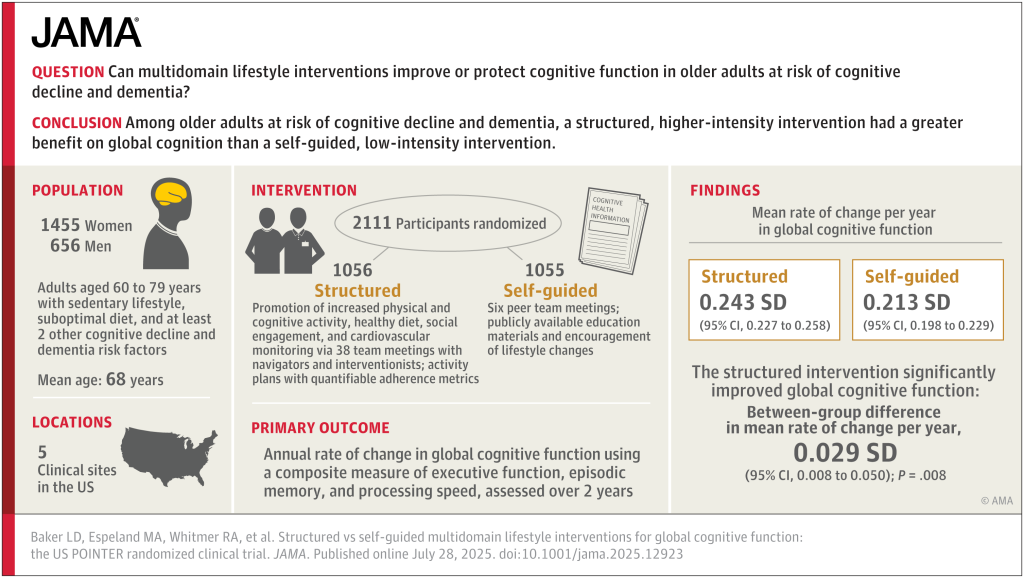
The results were compelling. Both groups experienced improvements in cognitive function, but the structured, supported group showed greater gains highlighting a truth we see in real life all the time: consistency and accountability drive results. Even more encouraging, these improvements occurred regardless of sex, ethnicity, genetic risk factors like APOE-4 status, or cardiovascular health status. That means your daily choices truly have the power to influence your brain, no matter where you’re starting from.
This study doesn’t stand alone. It builds on the groundbreaking FINGER Trial, published in The Lancet in 2015, which demonstrated that a multi-domain lifestyle intervention could significantly improve or maintain cognitive function in at-risk older adults.
Participants in that study showed a 25% higher overall cognitive score compared to the control group, with notable improvements in executive function and processing speed. The FINGER model has since become the gold standard in dementia prevention and has expanded globally through the WW-FINGERS network. It was the first large-scale randomized controlled trial to show that targeting multiple lifestyle factors simultaneously can protect brain health—even modest, consistent changes matter.
So, what does this mean for you? It doesn’t mean perfection, and it certainly doesn’t mean overhauling your entire life by next week. It means that small, consistent, supported changes do work. The way you move your body matters. What you eat matters. How you engage your mind and relationships matters. And having someone walk with you in that process guiding, supporting, and holding you accountable matters more than most people realize.
You don’t have to figure this out alone. If you’ve found yourself starting and stopping, feeling overwhelmed by all the information, or knowing what to do but struggling to follow through, this is exactly where coaching becomes powerful. This is the work I do every single day with CEOs striving for peak performance, college students navigating stress and direction, parents balancing full lives, and individuals who simply want to feel better in their bodies and minds. We take the science and translate it into real, sustainable life change.
If this sparked something in you, don’t let it stay as interesting information—turn it into action.
- Take a walk today.
- Add one brain-healthy food this week.
- Reach out and connect with someone meaningful in your life.
- Give yourself even a few minutes to pause and breathe, heart math style.
And if you’re ready to go deeper, schedule a coaching session with me. Let’s build structure, accountability, and momentum together because the research is clear: your brain is listening to how you live every day. “This isn’t fringe science anymore. Landmark trials like FINGER and the newly published U.S. POINTER study in JAMA are telling us something loud and clear: lifestyle isn’t just supportive it’s therapeutic.”
Will you answer ~ yes to a better brain?