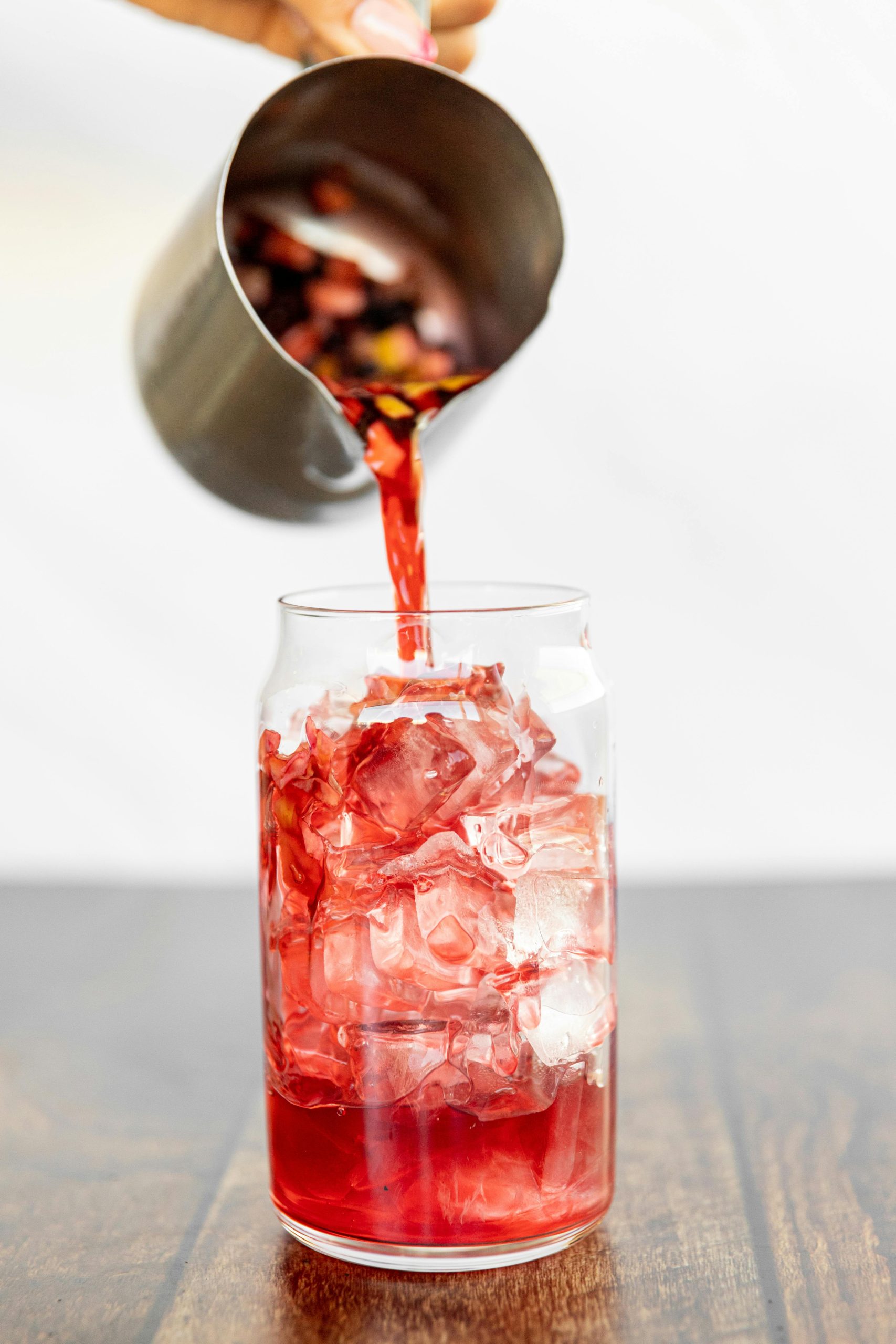
Hibiscus tea, or Roselle, is a standout leader in my running list of herbal success stories. Hibiscus is refreshing, tart, and fruity, with a vibrant ruby red hue. If you’re already a pink lemonade fan, this one is an easy sell. Served over iced during the summer months, hibiscus will cool you down, keep you hydrated, and take the edge off. It can also have significant physiological effects if enjoyed regularly!
A Natural Remedy with Proven Results
I’ve seen it time and again with my nutrition clients: when I suggest a daily glass or two of hibiscus tea, clients with high blood pressure often return reporting reduced and normalized readings.
While it thrills me every time I hear a positive tea testimony, it’s not a surprise herbal remedies like hibiscus work. Humans have been sipping on hibiscus tea for a solid 6,000 years, with archaeological evidence tracing back to 4,000 BCE in Sudan. Native to West Africa, word of hibiscus has crept around the globe and has become a mainstay in herbal traditions worldwide. You can now easily find bagged hibiscus tea hanging out right next to common chamomile and Earl Grey in most major grocery stores across the U.S.
What the Research Says
A recent systematic review and meta-analysis showed that hibiscus rivals pharmaceuticals in blood pressure lowering effects, particularly in those with existing hypertension. Just 2-3 cups a day may reduce systolic blood pressure by 7 mgHg and significantly reduce low density lipoprotein (LDL).
Hibiscus achieves these effects through multiple mechanisms.
- Anthocyanins, plant compounds famed for both anti-inflammatory and antioxidant activity, explain both hibiscus’ alluring color, as well in part, its heart healthy actions. Two types of anthocyanins found in hibiscus act as angiotensin converting enzyme (ACE)-inhibitors. While this enzyme typically works to constrict blood vessels, increasing pressure, hibiscus inhibits it, causing the blood vessels to relax.
- Hibiscus also contains a compound called quercetin that triggers the release of nitric oxide in the arteries, helping them expand and relax, while also signaling to the kidneys to increase urine outflow. A diuretic, ACE-inhibitor, and vasodilator–hibiscus is a triple threat! No wonder humans have stuck with this tea for so long!
If that wasn’t enough, the anthocyanins protect LDL particles from oxidation. When oxidized by free radicals in the blood, LDL particles really cause trouble, getting stuck to the artery walls, attracting plaque-forming inflammation. Plaque build-up worsens hypertension, a clogged pipe struggling to flow. Sipping on hibiscus tea provides the antioxidant shields capable of protecting LDL from free radicals, which helps keep arteries open, flexible, and healthy.
The Healing Ritual of Tea
Tea heals. Certainly, in the invitation to pause, savor, and unwind; the sensual delight of a hot or cold cup held in hand alone brings peace and calm. We know now, Hibiscus offers a deeper kind of physiological relief, with tangible changes to the arteries and blood flow. Consider opening your heart to hibiscus this summer and become the next success story. Check out the tips below to get started.
How to Brew and Enjoy Hibiscus Tea
Brewing tips:
- Brew it hot, then chill it.
Research comparing hot and cold preparations of hibiscus tea found, a hot infusion (hot water poured over top of dried herb and steeped) extracted the bioactive compounds, namely phenols, more thoroughly than a cold water extraction. - After steeping, let the tea cool to room temperature, then refrigerate for a refreshing iced version that goes down easy.
Daily dosage and consistency:
- Aim for at least 1 gram of dried hibiscus a day (about half a teaspoon)
- Commit to 4 weeks of daily use for consistent, meaningful results
Brewing instructions:
- Pour 8 ounces of boiling water over 1 to 1.5 teaspoons of dried hibiscus
- Steep for 15 minutes
- Strain and drink the entire cup (you can dilute it to taste but consume the full daily dose)
Additional recipe idea:
Check out Dr. Mark Hyman’s Young Forever Cookbook for a hibiscus rose syrup recipe. He served it at our summer picnic last year and it was heavenly over seltzer!
Final Thoughts
Tea heals — in the quiet ritual of brewing, in the sensory pleasure of a beautiful cup, and in the measurable improvements to heart health. Hibiscus tea offers an accessible, effective, and enjoyable way to care for your cardiovascular system. Give it a try this summer and discover the difference it can make.
REFERENCES
Alarcón-Alonso J, Zamilpa A, Aguilar FA, Herrera-Ruiz M, Tortoriello J, Jimenez-Ferrer E. Pharmacological characterization of the diuretic effect of Hibiscus sabdariffa Linn (Malvaceae) extract. Journal of Ethnopharmacology. 2012;139(3):751-756. doi:https://doi.org/10.1016/j.jep.2011.12.005
Da-Costa-Rocha I, Bonnlaender B, Sievers H, Pischel I, Heinrich M. Hibiscus sabdariffa L.–A phytochemical and pharmacological review. Food Chem. 2014;165:424-443. doi:10.1016/j.foodchem.2014.05.002
Ellis LR, Zulfiqar S, Holmes M, Marshall L, Dye L, Boesch C. A systematic review and meta-analysis of the effects of Hibiscus sabdariffa on blood pressure and cardiometabolic markers. Nutr Rev. 2022;80(6):1723-1737. doi:10.1093/nutrit/nuab104
Guardiola S, Mach N. [Therapeutic potential of Hibiscus sabdariffa: a review of the scientific evidence]. Endocrinologia Y Nutricion: Organo De La Sociedad Espanola De Endocrinologia Y Nutricion. 2014;61(5):274-295. doi:https://doi.org/10.1016/j.endonu.2013.10.012
Hopkins AL, Lamm MG, Funk JL, Ritenbaugh C. Hibiscus sabdariffa L. in the treatment of hypertension and hyperlipidemia: a comprehensive review of animal and human studies. Fitoterapia. 2013;85:84-94. doi:10.1016/j.fitote.2013.01.003
McKay DL, Chen CY, Saltzman E, Blumberg JB. Hibiscus sabdariffa L. tea (tisane) lowers blood pressure in prehypertensive and mildly hypertensive adults. The Journal of Nutrition. 2010;140(2):298-303. doi:10.3945/jn.109.115097
Ojeda D, Jiménez-Ferrer E, Zamilpa A, Herrera-Arellano A, Tortoriello J, Alvarez L. Inhibition of angiotensin convertin enzyme (ACE) activity by the anthocyanins delphinidin- and cyanidin-3-O-sambubiosides from Hibiscus sabdariffa. Journal of Ethnopharmacology. 2010;127(1):7-10. doi:https://doi.org/10.1016/j.jep.2009.09.059
Salem MA, Ezzat SM, Ahmed KA, Alseekh S, Fernie AR, Essam RM. A Comparative Study of the Antihypertensive and Cardioprotective Potentials of Hot and Cold Aqueous Extracts of Hibiscus sabdariffa L. in Relation to Their Metabolic Profiles. Frontiers in Pharmacology. 2022;13. doi:https://doi.org/10.3389/fphar.2022.840478
Serban MC, Sahebkar A, Ursoniu S, et al. Effect of sour tea (Hibiscus sabdariffa L.) on arterial hypertension: a systematic review and meta-analysis of randomized controlled trials. Journal of Hypertension. 2015;33(6):1119-1127. doi:10.1097/HJH.0000000000000556